About Interiors FurnishingsWorking with You Attache Design Press PGD Blog Contact Us
Showing posts with label balance. Show all posts

Wednesday, May 16, 2012

Does Balancing What's in Your Home Help Your Life?


Balance matters in your home.
Balance is an important design principle. I was thinking about this the other day because of a project I am working on. This project has odd windows placement making window treatments difficult to implement. I will be suggesting the windows be changed as it would bring a much better sense of balance to the room and the homeowner can get the panels framing the windows he so desires.

 Why is balance so important? 
We all crave it in our lives. Work time, family time, play time... we would like to achieve some sense of balance in our lives. It is no different when designing your home. What is balance when it comes to interior design? Balance is equilibrium both visually and psychologically. Balance pleases our senses and soothes our souls. The example above is balance though symmetry ~ mirror images from a center point. This is considered the most formal type of balance. It is lovely and very pleasing.


What if 'perfect' balance doesn't suit your eye and heart?
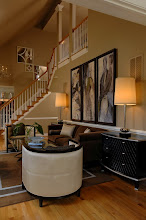
But what if mirror images simply cannot be done or it feels too formal for the desired outcome. Above is an example of asymmetry ~ optically varying items from a central point to achieve balance. The central point above is the art work. Note the floor vase with a great amount of mass. On the right hand side, the lamp is very similar in height to the vase but clearly doesn't have the mass to balance the vase. The chair adds the needed mass to gain a sense of balance. I used a grouping to balance the vase. The vignette is very pleasing and draws one into the center (the focal point) using asymmetrical balance.

Maybe a little of both will be the secret to happiness.
The picture at the top and the one just above are in a master suite.  These two forms of balance adds to the harmony, another design principle, in the room. The two types of balance, symmetrical and asymmetrical, adds interest to the room. Clearly the palette unifies; the type of balance adds the variety.


Can we talk?
What about this Jay Jeffers' design? This is radial balance ~ equilibrium based on the circle. Stadiums are often based on radial balance as the focal point is at the center.  Everyone can see the football game because they are sitting all around it.  A round dining table offers radial balance as everyone sitting at the table can see everyone else at the table.  This is a type of balance near and dear to my heart.  You may know I was a psychotherapist in my past career with a specialty in group psychotherapy.  I would arrange the circle perfectly so each member could see the other.  This fosters good communication.  The focal point really is each other.  It is easy to see the radial balance of a stadium and a round dining table but what about real life furniture arranging.  Jay did a nice job here.  The sectional forms half the circle; the single chairs the other half.  There is a fireplace and art as a secondary focal point but I see each other being the primary one in this vignette.

So what type of balance is right for you and your room?  
It all depends on what you're trying to accomplish and the space you have to work with.  Symmetrical can feel more formal; asymmetrical more artistic; and radial more communicative.  I have all three represented in my home.  That variety is simply pleasing to me. What about you?  Do you lean more towards one or the other?

Wednesday, February 10, 2010

Thursday's Room ~ The Art of Conversation

Andy Skurman

Today I am not going to focus on one specific well-designed room. I'm going to focus more on an art ~ the art of conversation at a lovely dinner party. This is where radial balance makes such a statement. I have written about radial balance before. There is no better place to realize it than in one's dining room. Take a look.....

Andy Skurman

Everyone is able to see each other equally well...

Craig Wright published in Architectural Digest

There is a feeling of togetherness...

Andy Skurman

Of belonging...

F. Pierpont Davis published in Architectural Digest

It is much cozier and welcoming with the round table.

I am craving to do a dining room with a big, beautiful round table. The tweens rooms I am doing right now are for clients that I will likely be doing their dining room shortly. It was supposed to be next on their list but the tweens spoke up and you know how that goes. So, the tweens first; then the dining room.

We already discussed the design a bit. She wants a big round table to seat her family for holidays. Alrighty ~ I can do that. I already found the table I would like to use...The Sheraton by Hickory Chair. I love that it is large but without great mass. I want to surround it with upholstered chairs for extreme comfort, which will add more mass and nicely balance the table.

That's my 'room' for today ~ designed with radial balance ~ rooms primed for the art of conversation.

What would we be talking about at dinner?

Thursday, July 23, 2009

Radial Balance ~ Fantastic Example!

Ok, so I was looking though some photos that I saved because they really stood out to me for one reason or another. I forgot I saved this one ~ this is an excellent example of radial balance.


I found this photo on Katie Denham's blog ~ Katiedid ~ a blog that I adore. I remember thinking when I saw the photo "what excellent radial balance." One would think I would remember it when I did the post, but no. Glad I was going through that folder! This room was done by Jay Jeffers for the Modern by Design Showhouse (2009).

As in great radial balance, the art of conversation is taken to a new level.

Radial Balance ~

Here is radial balance on a grand scale. Radial balance ~ a state of balance based on a circle.

When I lead group therapy, the design of the chairs was based on radial balance....


For the record, I am not in the picture. This is a stock photo to illustrate the point. Radial balance allows people to speak directly to each other with ease.....

Many dining rooms are based on radial balance......


Whether they are large or small dining rooms, there is no question that radial balance provides all with a fabulous seat at the table. Conversation flows easily.

Radial balance allows us to see a show, concert, or sporting event from all sides....


Here are some conversation areas that appear to be based on radial balance.


Some of these have other forms of balance but it appears the art of conversation was at the fore when these rooms were designs. That is what makes radial balance so wonderful and intimate ~ the art of conversation or enjoying the fantastic sight.

For more designs ~ visit Andrew Skurman's website. He is an architect that has mastered the art of radial balance.... his work is breathtaking.

Here is my recommended reading again for additional information ~

Tuesday, July 21, 2009

Asymmetrical Balance ~

This is a wonderful example of asymmetrical balance. Why? Asymmetrical balance is also known as informal balance. I adore asymmetrical balance because it is done with the eye ~ hence also being known as optical balance.

With asymmetrical balance, a center point or line is still found but differing furnishings are used to create balance. The furnishings need to be similar in mass or form and are still equal in distance from the center point.

In the above picture, the chairs are balanced by the chaise. The console table lamps are balanced by the shelving unit. This type of balance is more difficult to achieve. It requires searching for 'like' objects and then placing them, tweaking them, assessing the sight and feel of the arrangement, tweaking again.....

Once accomplished, it is delightful as it is already varied thus interesting and unlikely to become boring over time. This type of balance has a genuine, more relaxed feel to it but provides the same type of secure and confident feelings as symmetrical balance. When one enters into a room with good asymmetrical balance, the feeling of order occurs but is more subconscious than conscious. In symmetrical design ~ it is unmistakable as one sees the mirror image. In asymmetrical balance, one feels it first and then perhaps sees it.

Here are additional examples of asymmetrical balance....

The large vase is a similar height as the floor lamp, which flank the vignette. Since the vase has some mass, the chair together with the floor lamp, a grouping, provide the balance.

The sofa and chairs offset each other. They are unified by the chairs and a pillow on the sofa being similar colors.


The chair and the vase together balance the sofa. I love this design.

The white console (a horizontal plane), lamp, and drapes form a grouping that oppose the large white doors (a vertical plane). The bird cage counters the tree with hanging birds on a wire table. The area as a whole is given a sense of stasis. This is a very thoughtful design.

Photos compliments of Point Click Home.

As mentioned in my symmetrical balance post ~ here's a good read.

Monday, July 20, 2009

Symmetrical Balance ~


Over the next few weeks, I will be doing several 'educational' posts. I primarily started my blog to share interior design information. A home is quite personal and important to one's health on many levels. For an elderly person or one with disabilities, being able to function with ease and perhaps live independently is paramount (we'll be discussing universal design in the future). For children, growing up with surroundings that are safe, functional, stimulating, and soothing is important for their development. For adults, home is a place to function with ease, to feel comfortable, to close off the world when a rest is needed and to feel proud off when inviting family, friends, and colleagues in. A home is a place for our psychic to be eased, stroked, excited, and pleased. That is a tall order ~ one that I feel fortunate to be able to embrace. It allows me to marry my two fields of study.

Some of you know that interior design is a second career for me. My first was in the psychology field. I was in that field for too many years to mention. Here is the reality ~ you can take the girl out of the practice, but you can't take the practice out of the girl. Honestly, I feel it is helpful to have that background in my now chosen field of design. When I start working with a new client, I believe it is critical to get to know them, observe them, really hear them (each one of them as their thoughts and needs may differ) as I am helping them interpret their vision to create a home. Serious stuff. When I do my e-designs, I have a comprehensive questionnaire for clients to complete followed by an in depth telephone conversation. It is not quite the same intimacy I have with my face to face clients but I do the best I can and it has been quite successful. Some have asked me why I do e-design at all ~ well for the same reason I do the blog ~ to share interior design information. I honestly believe it is every one's right to have a place to call home. Not everyone can afford design services as they are typically done. An alternative is e-design or virtual design as I call it.

Why am I telling you all this?? ~ because when I have discussed the principles and elements of interior design previously, I didn't emphasize their significance to the soul and psychic. Next to functional, the most important aspects of design in my opinion. So that is what I am going to do ~ discuss their relevance and show you what I mean. I will start with the the principle of balance.

You hear designers speaking about 'balance' all the time. It is a very important principle in design but what does it really mean? One can imagine what it means since it is a common word and folks are always trying to achieve it in life everyday. Let's start by defining it.

Balance is equilibrium. It is the composition of furnishings that physically or visually provide a feeling of stability. This is important as this gives us a sense of security, a confidence about one's surroundings. This principle is accomplished in one of three ways ~ symmetrical or formal balance, asymmetrical or informal balance, or by radial balance. What?

Symmetrical balance is mirrored images. First a center point is found. Next what is placed on one side is exactly (or almost exactly) placed on the other side. Symmetry is not synonymous with traditional design. It is used in all types of design styles. Pictures always help.


In these pictures, you see the fireplace as the center. The window treatments and sofas/chairs are mirror images ~ the exact same thing ~ of each other. In the first picture, the tables are also symmetrical; in the second, the sconces are. Both pictures have puff ottomans visually aligned with the center point.

Here is a bedroom example.

Symmetrical balance is timeless and appears formal. It suggests order and refinement. One doesn't have to decipher what is happening in the room ~ it is predictable thus evoking a feeling of safety. To avoid having the predictability become boring (sounds like a relationship ~ well, my friends it is a relationship ~ a relationship with your home) there should be some asymmetry or, in other words, some variety. Look closely at the pictures. In the top library picture, the vases on the mantel are only on one side, on the tables closest to you, there is a lamp only on one. In the second, note the objects on the mantel and the single floor lamp. In the bedroom picture, note the white vases and their height/size. The asymmetry keeps the room as a whole with a needed breath of relaxation.

Here are some more examples of symmetrical designs. Note the asymmetry to add the variety and interest.


Here's the educator coming out in me again (I was an instructor at a university) ~ always give folks a great read to gain additional information. I will do this from time to time. A comprehensive book that gives the basics of interior design is Interiors: An Introduction by Karla J. Nielson and David A. Taylor.


Stay tuned. Later this week, we'll discuss asymmetrical and radial balance.
Blog Widget by LinkWithin