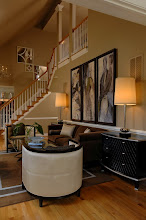
In Part III of my interview with Andy Skurman, we'll take a look at his Georgian style in all its glory! To read Parts I and II, click here.
We left off the interview finishing our conversation about his home with Francoise. Today we move to work topics ~ how did he persevere, his business philosophy, his work ethics, etc....... His views are fascinating and his conviction endearing. I listened intently.
Here we go.....
Paula: So you said you spent a lot of time in the museums and another question I had for you is when you were discussing it you said that you kind of went there on your own and you did your own research and you valued it. You said you had architects in the family, but did your family encourage this?
Andy: No. It really was a self-directed personal interest.
Paula: I know that you said that you had in the sixth grade you had your teacher – you were the best artist in the school. Tell me about that. Tell me about being a kid and being told that.
Andy: Well that felt really great. I worked very hard at it. I’ve always worked very hard at art and then afterwards in junior high and high school I had mechanical drawing and always concentrated on those subjects. I just really enjoyed them. I motivated myself. I just was interested in those things. When I graduated from high school the mechanical drawing teacher and the industrial arts teacher suggested to me that I become a mechanical drawing teacher. They thought I was so good at all this stuff that that’s what I should become, and I thanked them, but I knew that I wanted to try to be an architect.
Paula: I mean it sounds like it was a drive for you, something innate almost.
Andy: It was an obsession.
Paula: An obsession, but people tend to enjoy – this is a generalization, but people tend to enjoy things that they’re really good at.
Andy: Exactly.
Paula: From a very early age.
Andy: Yes, and I’d like to add something to that. Talent – I’ve read about this – talent comes from practice. Now this is in the new book by Malcolm Gladwell called Outliers. It’s a new best seller. He wrote Blink as well, and he says in there that talent is from practice, so the more you do something and the better you are at it, the more talented you are at that thing. I’ve been practicing my trade since I was 12 and I’m good at it now. I love it. It’s just second nature and I can really bring my experience to my projects and really help my clients designing great projects for them ‘cause I can be very creative with having so much practice at it.
Paula: Exactly. That’s what it sounds like. It sounds like they didn’t try to steer you away from it though, did they?
Andy: They did actually. My family did not want me to be an architect because my family was in the elevator business and their customers were architects, and they knew that most architects struggled and they just were afraid that it was a bad choice, but I needed to do it and I took the chance and did it, but they tried to dissuade me from it.
Paula: I mean that takes a pretty strong person to literally at such formative years, young age, to go against the family.
Andy: Right. It does, but I’m sure it’s the same for actors or actresses or other fields that are risky, or artists or writers, musicians. They’re all taking that chance.
Paula: So how did you become so successful then other than being fabulous at what you do?
Andy: I’d like to address that. One of the things that I’ve done in my career here was to specialize in classical architecture, which is a market niche, and by doing that and turning down modern work I was able to create a mini-brand for myself and become well known at something so that when someone is looking to build a house in the classical style or renovate a great classical house and they do the research maybe by speaking to contractors or designers or maybe even other architects, my name pops up as someone to interview. I really believe in keeping your niche narrow, becoming a specialist. Many, many designers do all kinds of great work. They do modern and they do traditional, and I can do it also, but I do traditional or classical in my office because I feel it is – how would I say it? It helps me create a professional identity that makes me unique in the field, so I think we do best at this kind of work in our region.
Paula: Well I mean certainly I would agree with you and certainly many people when they think about classical design, obviously you’re thought of. I even see that in the press in interviews, HGTV Top Ten. That’s frankly how I came to decide to call you, my first architect that I’m interviewing, because of your niche and because of the work that I’ve seen you’ve done. I commented on my blog when I was talking about radial balance and I just kept coming back to you because of your round rooms that end up in this beautiful work that you do, which is pretty – I think round rooms are obviously more unusual and you do them so well that I just kept going back to that, but I couldn’t get any pictures off of your website.
Andy: Oh you couldn’t? We’re happy to send you any pictures you want.
Paula: But I did link my blog to your website and said, “Take a look at this. This is what you need to look at if you really want to see very well done radial balance”, but I would really like some pictures so I could use in the blog post.
Andy: We’re happy to send them to you.
Paula: Yes, so I can really show off your work.
Andy: That’s fine. No problem at all there. I think it’s a matter of finding what you love and following it and not being distracted and really being discerning about the projects you take.
Paula: You know I’ve heard both sides, but it seems as if the people that are just wildly successful seem to have a niche. They seem to have just developed their own style or adopted styles that were true to them, true to their innate love and just run with that and become the best they can be with that.
Andy: I think it’s a good business strategy, but it also works in terms of – so anyway, I decided to do that, started my firm and it’s worked, and I have to tell you that in the downed economy if I hadn’t distinguished myself I would not be getting the work that I get now because it would be diluted. I’d have modern and traditional and deco and cabin. You know what I mean? It would be all over and I’d be lucky to be able to get my work that kept my practicing specific, but there’s so much variation in the classical architecture. There’s so much creativity within it. I find it more creative than modern architecture because – I’d like to discuss with you the difference between art and design.
Paula: Okay.
Andy: Because I know of your great interest in art. In design it’s really about looking at historical precedence and drawing something that’s going to be made as opposed to in art where you do the drawing or you do the painting. That’s the big difference between art and design is that when I think – I don’t do art on the side. I design it maybe on the side. Maybe that’s where the Andy Designs thing is from because I’m just a designer. I’m not a fine artist, and there’s a really big distinction there in my mind. It’s very clear to me the difference.
Paula: Where the artist is the one that actually picks up the paintbrush and paints the picture where the designer is the one that sort of sketches it out?
Andy: Or draws it or has a drawing to have it made by someone else, and that’s really what I do. I’m a designer. I’m not a fine artist.
Paula: Right.
Andy: What was the other thing I was going to explain? Oh boy. I forgot.
Paula: Well I mean there is definitely -
Andy: Oh. Now I can address the difference between working in the modern idiom versus the classical idiom. In the classical idiom I have a great library of books on Italian architecture and French and English and German and Spanish and great books of American architecture, of everything from contemporary people doing it to books that are from the 18th century. What we do in classical is find historical precedence. No one invents a column here. No one invents a molding. No one invents the scale of the molding in the room. We go by the rules. There are rules from ancient Greece that prescribe all of these relationships in proportions, and we use them. My staff when they’re working on projects, I wanna see the precedent because I wanna see what we’re being inspired by ‘cause we’re not here to invent things, whereas looking in the modern idiom it’s all about inventing.
Paula: Right.
Andy: It’s not about looking at anybody’s work or anything that’s been done before. That’s looked down upon. It’s all about invention and classical is about invention within the historical precedence of the past. It’s inspired by something from the past. It works for me really well. I like looking at history books and being inspired by them.
Paula: Do you mix? Do you take certain rules from or guidelines from Greece and marry them with other elements let’s say from Italy or from another period and blend it all together?
Andy: Yes. I also blend it with modern ideas. Our houses have the high tech audiovisual systems and we have great bathroom fixtures that are contemporary. For instance we might do a shower door but etch the glass to match the panel door that is made of wood that is the entrance to the bathroom, so we would do an etched design that matches that paneling on the glass door to the shower.
Paula: Okay, so you interpret the -
Andy: Yes. It’s being inspired by the task but not being literal about it. You’re literal to a certain degree just to make sure the proportions are right because if the columns are too thin or too heavy or the moldings are too skimpy the room just doesn’t sing.
Paula: Right.
Andy: And we don’t take our moldings from catalogues. We design them and have them made.
Paula: Oh, that’s – have you just not found someone that does it to your liking or is it more about just the authenticity and maintaining that?
Andy: Well it’s about being totally creative and about having things made locally and it’s about the fact that it really doesn’t cost more money because blades that cut the moldings only cost a couple hundred dollars, so you can design your own moldings for the same price as buying them out of a catalogue and having them made, which gives you total flexibility and total creativity.
Paula: Right. Exactly. That’s the part that I was wondering about, the creativity part. That’s why I asked about do you mix it up in a way, the classical styles?
Andy: Definitely. For instance the Louis XV period was the most voluptuous moldings, but they also had the carved boiseries and all the very curved edges to all the panels on the wall, but I like to do straight lines, which is more of a Louis XVI period, but I use the moldings from the Louis XV period ‘cause they’re the most voluptuous, and I combine the two styles in the way I like it to be detailed best.
Paula: You were talking about the difference between designing and the artistry. I understand the difference as you explain it, although I do think that it takes an artistic eye or an artistic mind to put together those designs.
Andy: Absolutely. You’re absolutely right, but it’s just a matter of the final product is not from your hand.
Paula: Correct. Okay. That’s what I understood. They’re different and distinct, but I think they’re grossly related. The designer must have that sort of ability in their mind to see things or even how it’s going to feel.
Andy: Oh, you have to think three-dimensionally. You really have to be able to really project yourself in the space. You have to really understand what makes a great sequence of spaces and proportions for the rooms and rooms to fit the furniture and the light coming into the rooms. All of that has to be taken into account.
Paula: Right. I wanna ask you, we’re talking about your business and we’re talking about your own home, and now true to my form I wanna talk about the person that you are and at a very young age having the moxie to follow your own path and do this. I’m just wondering how you believe the art and design work has influenced you as a person.
Andy: That’s a very good question. It’s not an easy life because most places that I go I find fault with the design. Even going to a hotel is hard because – and I designed a hotel recently by the way. I did the interior architecture on a hotel called The Resort at Pelican Hill.
Paula: Okay, and where is that?
Andy: That’s in Newport Beach, California. Do you wanna hear a great story about clients?
Paula: Sure.
Andy: I tell my staff that they should really work hard for their clients and for their contractors and they should make the best impression they can with everyone they come in contact with because you never know where work comes later. When I was I think about my late 20’s I moved from IM Pay to SOM San Francisco and I was put in charge of an account called the Irvine Company, which owns a large portion of Orange County, California, and I would fly there every week to meet with the chairman of that company. We did office buildings and I worked on them really hard. I knew every inch of them and after I left SOM and went to Gensler I lost touch with those clients at the Irvine Company, but just a couple of years ago I got a call from the chairman of the Irvine Company asking if I would fly down and meet with him, and he evidently followed my career and found that I had transformed myself from a designer of modern office buildings to a designer of luxury residential homes, and he wanted that feeling for his hotel. We ended up doing it and there was a hiatus in there of 15 years.
Paula: That’s a long time.
Andy: Long time. I never expected to hear from him again, but he told me that the office buildings we did together were the best he’s ever done and he trusted me and wanted me to do the hotel.
Paula: Wow.
Andy: So you never know where clients come from and you always really need to do the best you can do and treat people the best way you can and it might come back in the end.
Paula: I believe that too. That’s interesting. I mean obviously you made a wonderful impression on him and he was very impressed with your work if he followed your career, and then when you created your niche so to speak and he actually called you up. Clearly you left a very good and rich impression on him.
Andy: Oh, we worked really hard together. [Laughs] He’s an owner that’s very interested in the design of his buildings and his communities and we had a good working relationship.
Paula: So you were saying -
Andy: He’s currently one of the richest men in the world.
Paula: Oh great! That’s great when you can do business with somebody who -
Andy: Yeah. No one even knows him and no one gets to meet him. It’s one of those things that we know each other forever.
Paula: I don’t know. I think that might be better because then no one can bother him.
Andy: Right. No. He stays under the radar lately.
We'll take a look at Andy's work at The Resort at Pelican Hill next time with the portion of the interview that covers hotels.
What do you think about his business philosophy? Brilliant, I think. I would have to say my niche is transitional design as it is my favorite style. What about you?
Next time Andy and I focus on education, working with interior designers, his fee structure ~ yes we even discuss that ~ hotel recommendations........
Part IV will be posted next Tuesday.
Here are Andy's wonderful examples of Georgian Style. Enjoy!
RESIDENCE IN THE GEORGIAN STYLE
.jpg)
.jpg)
.jpg)
.jpg)
.jpg)
.jpg)
.jpg)
.jpg)
.jpg)
.jpg)
.jpg)
CONTRACTOR: Tincher Construction
LANDSCAPE DESIGN: May Arborgast
PHOTOGRAPHY: Mark Darley
VILLA IN THE GEORGIAN STYLE


INTERIOR DESIGN: Tucker and Marks, Inc.
LANDSCAPE DESIGN: Elizabeth Everdell Garden Design
CONTRACTOR: Plath and Company
PHOTOGRAPHY: Mark Darley
PENTHOUSE RENOVATION IN THE GEORGIAN STYLE (I love this one! In addition to the magnificent architecture they see everyday, look at the views from the windows.)


 INTERIOR DESIGN: Fisher Weisman Design and Decorations
CONTRACTOR: Ryan Associates
PHOTOGRAPHY: David Duncan Livingston
Once again, Andy's beautiful structures are adorned by very talented interior designers.


 INTERIOR DESIGN: Tucker and Marks, Inc.


 Posts
Posts